
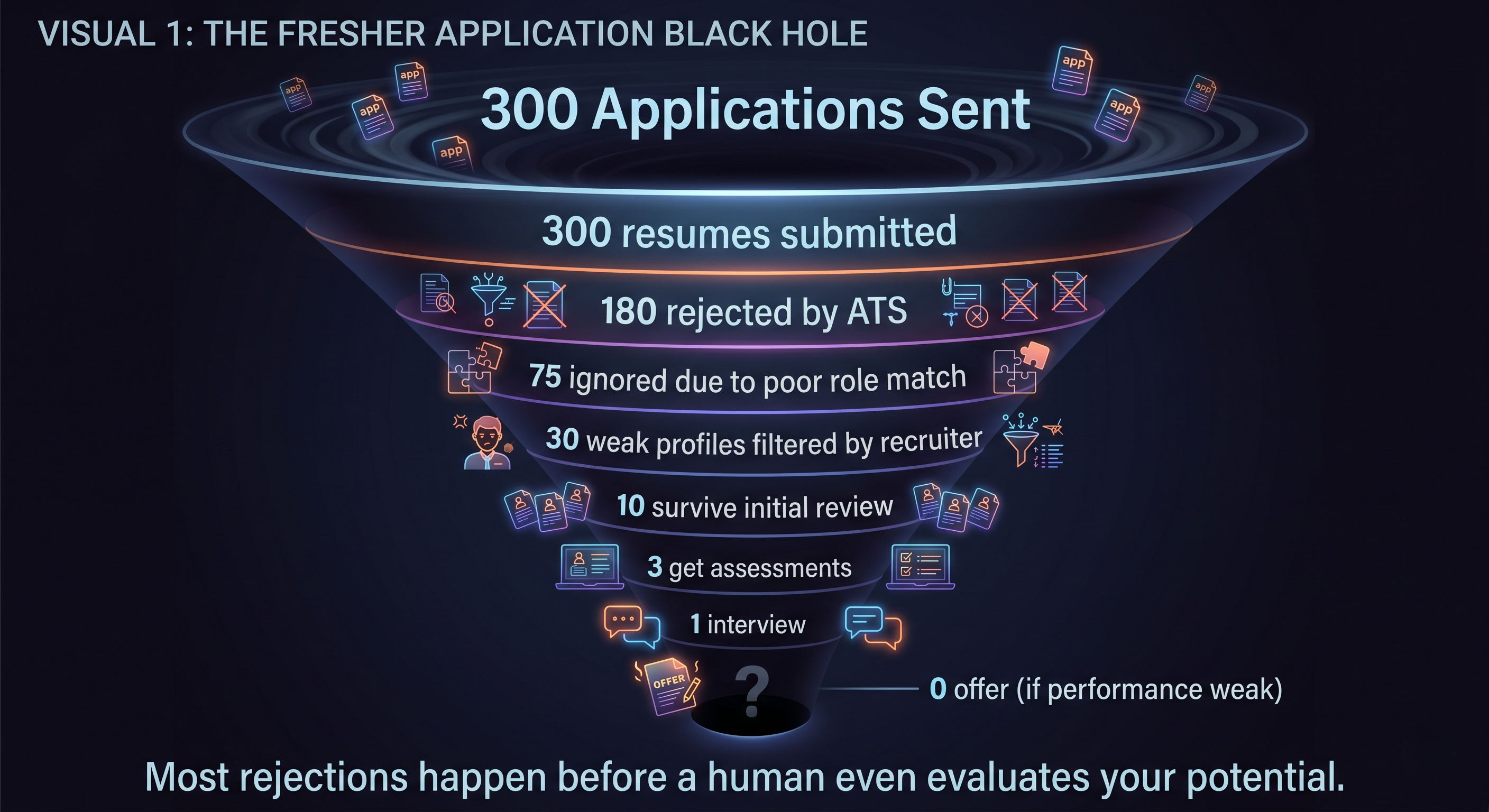
You did what everyone said. Built a resume. Learned SQL. Maybe Power BI. Maybe Python. Completed projects. Applied to jobs. Then applied to more jobs. Then easy-applied to 50 more because maybe volume was the answer. Then 100 more. Then 300. Silence.
No interview. No recruiter call. Maybe one automated rejection email at 2:13 AM.
And eventually, the internal spiral begins: "Is the market dead?" "Am I not good enough?" "Do companies only hire referrals?" "Was learning data analytics a mistake?"
This is where most freshers are right emotionally, but wrong diagnostically. Because yes — something is broken. But it’s usually not what you think.
The problem is rarely: "There are zero jobs."
The problem is usually: Your application is not surviving the hiring funnel.
That distinction matters. Because if the issue is your strategy, it’s fixable. If you think the issue is your worth, you’ll quit too early.
Let’s Be Honest About What’s Happening
Most freshers think job applications are meritocratic: Learn skills → apply → interview → get selected. Reality is messier. Hiring is a filtering game. Companies are not trying to discover hidden talent from 1,200 applicants. They’re trying to eliminate risk quickly.
That means:
- Imperfect filtering
- Rushed screening
- Keyword-based elimination
- Recruiter shortcuts
- Assumptions based on weak signals
This is frustrating. But understanding it changes your strategy.
Reason #1: Your Resume Does Not Match the Role
This is the biggest issue. Not bad resumes. Mismatch resumes.
Example: A company hiring an entry-level product analyst wants:
- SQL
- Excel
- Dashboards
- Experimentation mindset
- Business metrics
Your resume says:
- Python
- Machine learning
- Sentiment analysis
- Image classification
- Titanic project
You may be smart. You may be capable. But to the recruiter? Wrong fit. Rejected. This happens constantly.
Many freshers build one generic resume and blast it everywhere. That approach quietly kills opportunity.
What to do instead: Build 2–3 role-specific resumes. For example:
- Resume A: Data Analyst (Focus: SQL, dashboards, reporting, Excel, business analysis)
- Resume B: Product/Business Analyst (Focus: metrics, funnels, cohort analysis, experimentation, retention)
- Resume C: Data/Analytics Generalist (Balanced profile)
Your resume should mirror the job, not your entire learning history.
Reason #2: ATS Is Filtering You Before Humans See You
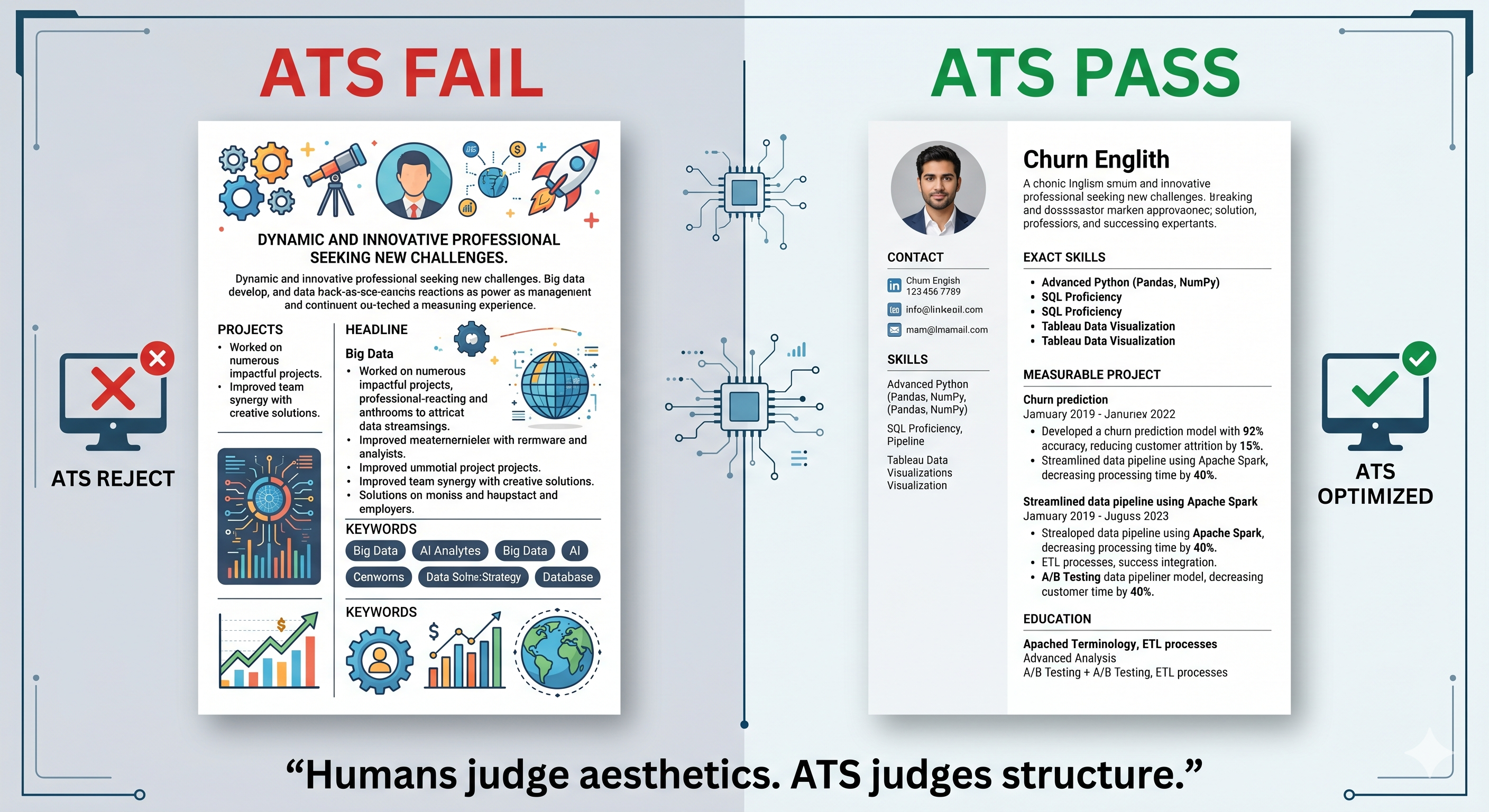
Many applicants never reach a recruiter. Applicant Tracking Systems scan for relevance.
That means:
- Keywords
- Job title alignment
- Skills match
- Formatting readability
Common mistakes:
- Fancy Canva resumes
- Graphics-heavy layouts
- Vague descriptions
- Missing exact keywords
- Poor structure
ATS doesn’t care that your resume “looks modern.” It cares whether it can parse information.
What works:
- Bad: "Worked on multiple interesting analytics tasks."
- Better: "Built SQL-based customer retention analysis dashboard using Power BI."
Specificity wins.
Reason #3: Your Portfolio Looks Like Everyone Else’s
This one hurts. Because effort was real. But sameness destroys differentiation.
Recruiters repeatedly see:
- Netflix dashboards
- Spotify dashboards
- Titanic dataset analysis
- Generic sales dashboards
- Tutorial projects copied from YouTube
Problem? You look interchangeable. And worse — many candidates cannot explain their own work. That destroys trust instantly.
Better approach: Build projects around a domain.
- If you care about ecommerce: conversion funnel analysis, customer retention breakdown, or pricing sensitivity study.
- If you like fintech: fraud behavior patterns, transaction cohort analysis, or repayment behavior insights.
- If SaaS interests you: churn analysis, activation metrics, or retention cohorts.
- If healthcare interests you: patient flow optimization, appointment no-show analysis, or resource allocation insights.
The goal is not “more projects.” The goal is more believable projects.
Reason #4: You’re Applying Too Broadly
Many freshers apply to: data analyst, business analyst, MIS executive, data scientist, product analyst, operations analyst, reporting analyst, and growth analyst.
That sounds efficient. It often creates confusion. Your profile becomes unfocused. Recruiters struggle to understand what you actually are.
Specialization creates stronger signals. Even early on.
Reason #5: Your LinkedIn Profile Is Quietly Hurting You
Recruiters check LinkedIn. Not always. But enough.
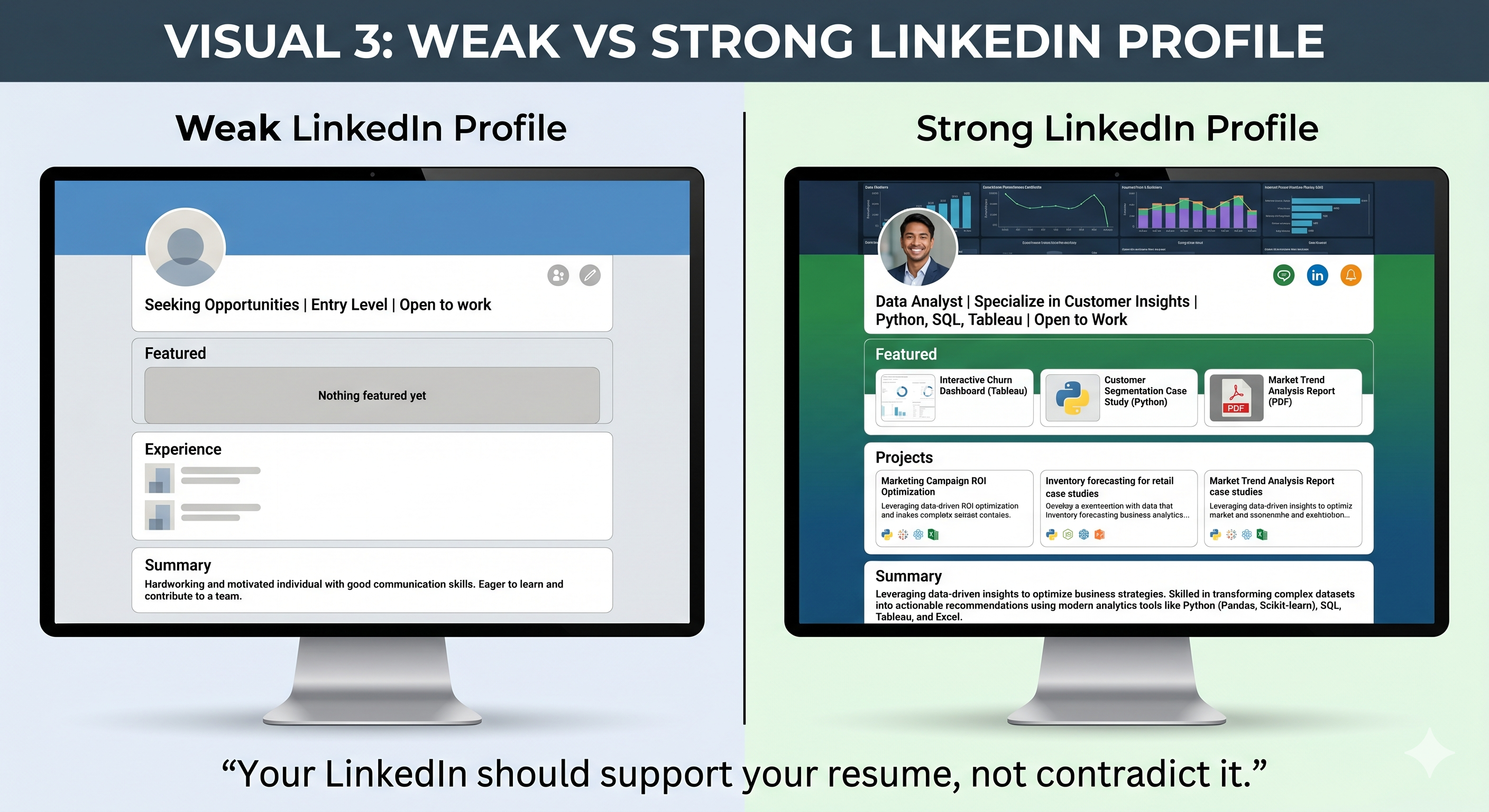
Weak LinkedIn signals:
- Headline: "Aspiring professional seeking opportunities"
- About section: Generic motivational paragraph
- Experience: Empty
- Projects: Missing
- Skills: Random clutter
- Profile photo: Missing or unprofessional
This creates doubt. Not because LinkedIn gets you every job. Because inconsistency creates friction.
Better:
- Headline: Entry-Level Data Analyst | SQL | Power BI | Customer Retention Analysis (Not: "Dreamer | Learner | Future Leader")
- Be concrete.
Reason #6: Generic Applications Don’t Work Anymore
Mass applying feels productive. It often isn’t. A generic application says: "I want a job." A targeted application says: "I fit this role." Those are different signals.
Companies don’t reward desperation volume. They reward relevance.
Better strategy: 30 high-quality applications > 300 random ones
Reason #7: Weak Communication Kills Interviews
Many technically decent candidates fail here. Because analytics is not just tools. It’s decision support.
Interview question: "What did you find in your project?"
Weak answer: "I created charts using Power BI and SQL joins."
Strong answer: "I found repeat customer drop-off after second purchase, suggesting retention—not acquisition—was the larger issue."
Same project. Different candidate perception. Communication changes outcomes.
Reason #8: You Have No Experience Signal
“But I’m a fresher.” Yes. That’s understood.
But employers still need evidence. That can come from:
- Internships
- Freelance work
- Project consulting
- Volunteer analytics work
- Self-driven case studies
- Domain-focused portfolio work
Experience is broader than payroll history.
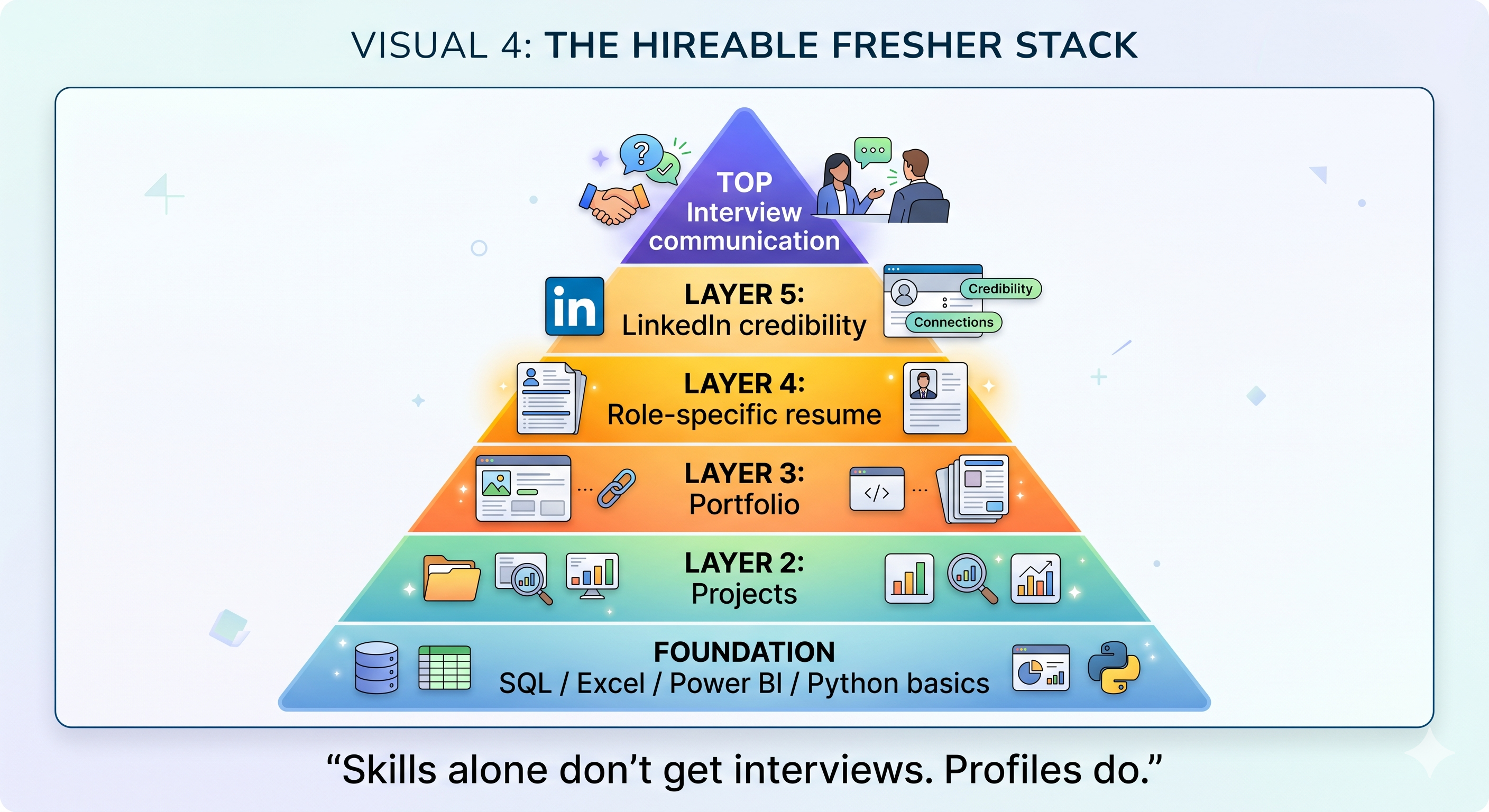
The Real Fix: Build a Profile, Not Just Skills
This is where strategy changes. Stop thinking: "What else should I learn?" Start thinking: "What profile am I presenting?"
A hireable fresher profile includes:
- ✅ Role-specific resume
- ✅ ATS-friendly formatting
- ✅ Focused LinkedIn
- ✅ Believable portfolio
- ✅ Domain-specific projects
- ✅ Interview communication
- ✅ Some evidence of execution
That’s what reduces employer risk.
Final Thought
If you’ve applied to 300 jobs and heard nothing, the emotional conclusion is: "I’m failing." The more accurate conclusion is: Your market positioning is failing. That’s much better news. Because positioning can be fixed.
A fresher who applies blindly looks invisible. A fresher with focused positioning looks hireable.
The market is competitive. Yes. But competition does not mean randomness. It means stronger signaling wins.
Stop sending more applications. Start becoming easier to say yes to.
Grit Over Excuses.
— The Grito Team